Model of Emergence
Model of Emergence
From “Rethinking Suicide: Why Prevention Fails, and How We Can Do Better” - Craig J. Bryan
Key Assumptions of Emergence
1. Change is constant.
2. The whole is greater than the sum of its parts.
3. Each component of a system depends on the other components to function.
4. Complex systems behave in nonproportional ways.
This is, in essence, the central implication of Franklin’s meta-analysis: a lot of things are correlated with suicidal behaviors but none of those things has an especially strong correlation and none of those things is sufficient to explain suicide. An important implication of this assumption is that suicide can result from many different combinations and configurations of these same variables. In other words, there is no single “right” combination of suicide risk and protective factors; many, many, many different combinations of these factors can lead to suicide.
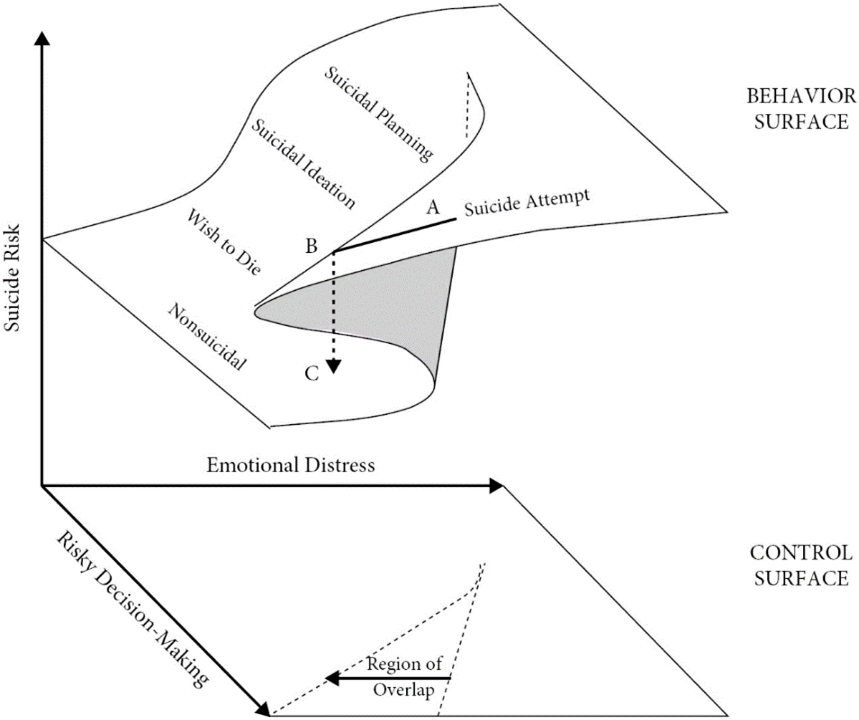
Because of nonproportionality—the fourth key assumption of emergence—change can sometimes be both smooth or continuous and other times be sudden and jarring, almost as if it came out of the blue. Both are possible, but only if we move beyond the unidimensional continuum model of suicide risk.
Many (though not all) of my patients often said that they didn’t necessarily feel any better or any worse than they had the day before (or the week or the month before that). On the contrary, they often explained that they “just couldn’t take it anymore,” implying that they had crossed some boundary that lies between attempting suicide and not. When I would ask these patients what had changed in the time leading up to their attempt, they often couldn’t identify a precipitating event or point to a particular reason. “I don’t know,” many of them said. “It just happened.” A relatively small change—a slight nudge—had effectively pushed them past this tipping point, resulting in a catastrophic outcome.
Tipping Point / Threshold
Individuals who died by suicide often seemed to be doing reasonably well right up until the moment they were attempting suicide, as if they had crossed over some sort of threshold or tipping point.
The tipping point between two discrete suicide-risk states provides the basis for the fourth property of the cusp catastrophe model: Very small changes in conditions can lead to very different outcomes. If this property sounds familiar, that’s because it is also one of the key assumptions of emergence: nonproportionality.
While in a state of suicidal mulling, the very slightest of nudges in either direction could make the difference between returning to a lower risk state or transitioning to a higher risk state where the probability of suicidal behavior is greatly increased.
When someone is not at the tipping point, very large changes in stress could have hardly any impact on their suicide-risk level.
Patients who had a very strong wish to die combined with no wish to live—the highest score possible—were more than six times more likely to die by suicide than everyone else. Among patients who had at least some wish to live, however, the risk of suicide was significantly reduced, suggesting that even a small wish to live could offset a whole lot of wish to die. Conversely, a relatively small decline in the wish to live could precipitate the emergence of suicidal behavior.
When it comes to the tipping point between suicidal behavior and the absence of it, the wish to live seems to carry somewhat more weight than the wish to die.