
Virgin Birth
|
|
Virgin BirthAlso called parthenogenesis, it is the birth of an offspring without male fertilization. |
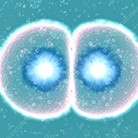
Parthenogenesis from the Greek παρθένος, parthénos, 'virgin' + γένεσις, génesis, 'creation') is a natural form of asexual reproduction in which the embryo develops directly from an egg without need for fertilization. In animals, parthenogenesis means development of an embryo from an unfertilized egg cell.
Parthenogenetic offspring in species that use the XY sex-determination system have two X chromosomes and are female.
Among vertebrates, strict parthenogenesis is only known to occur in lizards, snakes, birds, and sharks.
In humans, sometimes an embryo may begin to divide without fertilization, but it cannot fully develop on its own; so while it may create some skin and nerve cells, it cannot create others (such as skeletal muscle) and becomes a type of benign tumor called an ovarian teratoma. Spontaneous ovarian activation is not rare and has been known about since the 19th century. Some teratomas can even become primitive fetuses (fetiform teratoma) with imperfect heads, limbs and other structures, but are non-viable.
In 1995, there was a reported case of partial human parthenogenesis; a boy was found to have some of his cells (such as white blood cells) to be lacking in any genetic content from his father. Scientists believe that an unfertilized egg began to self-divide but then had some (but not all) of its cells fertilized by a sperm cell; this must have happened early in development, as self-activated eggs quickly lose their ability to be fertilized.
After an independent investigation, it was revealed that the discredited South Korean scientist Hwang Woo-Suk unknowingly produced the first human embryos resulting from parthenogenesis. Although Hwang deceived the world about being the first to create artificially cloned human embryos, he contributed a major breakthrough to stem cell research by creating human embryos using parthenogenesis.
Luke 1:26-38 Six months after Elizabeth had become pregnant, God sent the angel Gabriel to Nazareth, a city in Galilee. The angel went to a virgin promised in marriage to a descendant of David named Joseph. The virgin’s name was Mary.
When the angel entered her home, he greeted her and said, “You are favored by the Lord! The Lord is with you.”
She was startled by what the angel said and tried to figure out what this greeting meant.
The angel told her,
“Don’t be afraid, Mary. You have found favor [a] with God.
You will become pregnant, give birth to a son,
and name him Jesus.
He will be a great man
and will be called the Son of the Most High.
The Lord God will give him
the throne of his ancestor David.
Your son will be king of Jacob’s people forever,
and his kingdom will never end.”
Mary asked the angel, “How can this be? I’m a virgin.”
The angel answered her, “The Holy Spirit will come to you, and the power of the Most High will overshadow you. Therefore, the holy child developing inside you will be called the Son of God.
“Elizabeth, your relative, is six months pregnant with a son in her old age. People said she couldn’t have a child. But nothing is impossible for God.”
Mary answered, “I am the Lord’s servant. Let everything you’ve said happen to me.”
Then the angel left her.
Mary resided in "her own house"in Nazareth in Galilee, possibly with her parents, and during her betrothal—the first stage of a Jewish marriage. Jewish girls were considered marriageable at the age of twelve years and six months, though the actual age of the bride varied with circumstances. The marriage was preceded by the betrothal, after which the bride legally belonged to the bridegroom, though she did not live with him till about a year later, when the marriage was celebrated
It is not told how old Mary was at the time of the Nativity, but attempts have been made to infer it from the age of a typical Jewish mother of that time. Mary Joan Winn Leith represents the view that Jewish girls typically married soon after the onset of puberty, while according to Amram Tropper, Jewish females generally married later in Palestine and the Western Diaspora than in Babylonia. Some scholars hold the view that among them it typically happened between their mid and late teen years.
As a side note, under Canadian law, it is illegal to impregnant a minor, such as a 12 year old girl. As well, youth under the legal age are not old enough to give legal consent to any persons altering their reproductive organs. Such persons who do so are guilty of serious sexual offences.