
Common Beliefs of Suicide that are Actually Wrong
Common Beliefs of Suicide that are Actually Wrong
Society assumes suicide is pretty simple… from idea to action, or as simple as time passing from past to future. But its not. Much like a scene of a conversation in an episode of “Doctor Who” that I like.
Doctor Who – Episode: “Blink”
WOMAN: How? How is this Possible? Tell me.
DOCTOR: People don’t understand time. It’s not what you think it is.
WOMAN: What is it?
Doctor: Complicated.
WOMAN: Tell me.
DOCTOR: Very Complicated
WOMAN: I’m clever and I’m listening. And don’t patronize me, because people have died, and I am not happy. Tell me.
DOCTOR: People assume that time is a straight progression from cause to effect, but actually, from a non-linear, non-subjective viewpoint, it’s more like a big ball of wibbly wobbly, timey-whimy, stuff.
From the suicide model of Emergence, with the tenets being:
- Change is constant.
- The whole is greater than the sum of its parts.
- Each component of a system depends on the other components to function, and
- Complex systems behave in nonproportional ways.
Put into a “non-linear, non-subjective viewpoint” of a 3D representation with axis’s for “emotional distress”, “suicidal risk” and “risky decision making”, it actually does look sort of like a big warped sheet of “wibbly-wobbly, timey-whimy stuff”
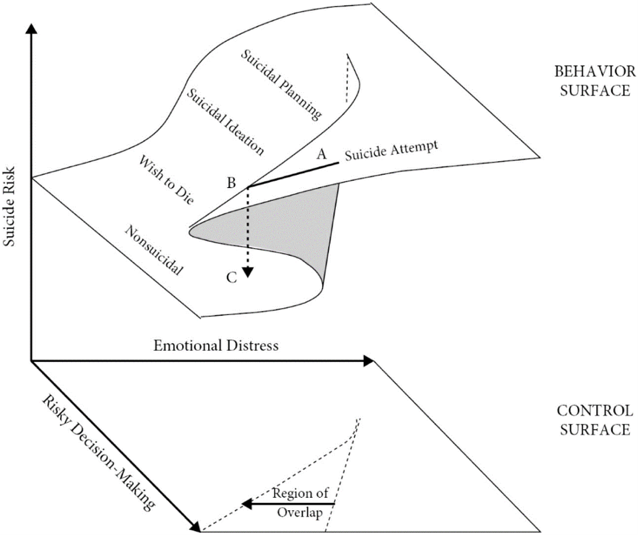
From “Rethinking Suicide: Why Prevention Fails, and How We Can Do Better” - Craig J. Bryan
Mental illnesses DO NOT cause suicidal behavior
Over and over again, some version of the refrain, “it just happened,” was offered as an explanation—in many cases accompanied by a confused shrug of the shoulders and resigned shake of the head. Over and over again, I’ve been struck by how many of these cases did not involve a history of mental illness or mental health treatment, no known or reported history of suicidal thoughts and behaviors, and little to no evidence of a current mental illness.
If these people had not engaged in suicidal behavior, their reactions would typically be considered “normal” by most standards and would not have reasonably led to the diagnosis of a mental illness, not even an adjustment disorder.
Only 46% of U.S. citizens who died by suicide between 1999 and 2016 had a known mental health diagnosis at the time of death.
Research studies suggest mental illness is only weakly correlated with suicide.
Healing depression WILL NOT heal suicidality
Many different types of mental health treatments reduce depression, but only a handful of treatments have also been shown to reduce the probability of suicidal behaviors.
If mental illness caused suicidal behavior, we should expect that treatments that reduce depression and/or other symptoms of mental illness would be just as good at reducing suicide attempts, but that’s not what we see at all.
Half of suicide attempts occur within five to 20 minutes of deliberation over the act.
In a study conducted by Marianne Wyder and Diego De Leo, two out of three individuals who were interviewed soon after they had attempted suicide denied experiencing one or more of these intermediate levels of the suicide-risk continuum. In this study, six out of 10 individuals who attempted suicide said they did not make any plans or arrangements to take their lives prior to attempting suicide, three out of 10 reported they did not seriously consider taking their own life, and two out of 10 reported they did not think about taking their lives at all. Approximately half of U.S. adults who have attempted suicide similarly deny they had made a plan in advance.
Millner interviewed 30 individuals who had recently attempted suicide and asked these individuals to reflect upon their experiences leading up to the attempt. On average, participants reported the following timeline:
- Five years prior to the attempt, they first experienced suicidal thoughts and experienced these thoughts off and on for several years
- Two weeks prior to the attempt, these suicidal thoughts increased in intensity and frequency, such that they were occurring nearly continuously
- One week prior to the attempt, they started to think about where to attempt suicide
- Six hours prior to the attempt, they experienced an internal debate about whether or not to attempt suicide
- Two hours prior to the attempt, they decided upon which method to use
- Thirty minutes prior to the attempt, they decided where to make the attempt
- Five minutes prior to the attempt, they made the final decision to act.
There are NOT always “signs” to look for
The unexpected nature of many suicide deaths stands in sharp contrast to the suicide prevention community’s assertion that suicidal behaviors are preceded by warning signs or indicators that signal the behavior’s emergence.
For every person who talked about wanting to die or killing themselves and then died by suicide soon thereafter, there were 17 people who talked about wanting to die or killing themselves who then died soon thereafter of a cause other than suicide.
The majority of suicide decedents may therefore show one or more warning signs for suicide but very few individuals who show these warning signs will actually die by suicide.
In other words, 99.97% of those who said they were having no thoughts of death or self-harm and 99.7% of those who said they were having thoughts of death or self-harm nearly every day were still alive one year later.
Thoughts about suicide or wanting to die should be taken seriously because they reflect being in a vulnerable state, but they do not necessarily lead to suicide.
99.6% of those who say they are having no thoughts of death or self-harm as compared to 96% of those who say they are having these thoughts nearly every day did not make a suicide attempt in the year after they reported having thoughts about death or self.
Although more than half of those who attempt suicide or die by suicide previously reported thoughts about death or self-harm, very few individuals who experience thoughts of death or self-harm will attempt suicide or die by suicide.
Approximately 1 in 7,692 individuals die by suicide and 1 in 303 individuals attempt suicide in the United States each year. If someone reports suicidal thoughts, the likelihood of dying by suicide in a given year increases to approximately 1 in 6,250, and the likelihood of attempting suicide in a given year increases to 1 in 204. Knowing that someone is thinking about suicide is therefore better than not knowing, but not by much.
What this all reveals is a key challenge for suicide prevention: any given warning sign for suicide will be wrong far more often than it will be right.
A significant percentage, therefore, of individuals who attempt or die by suicide deny having any suicidal thoughts at all.